When AI agents start managing the work, what happens to the managers?
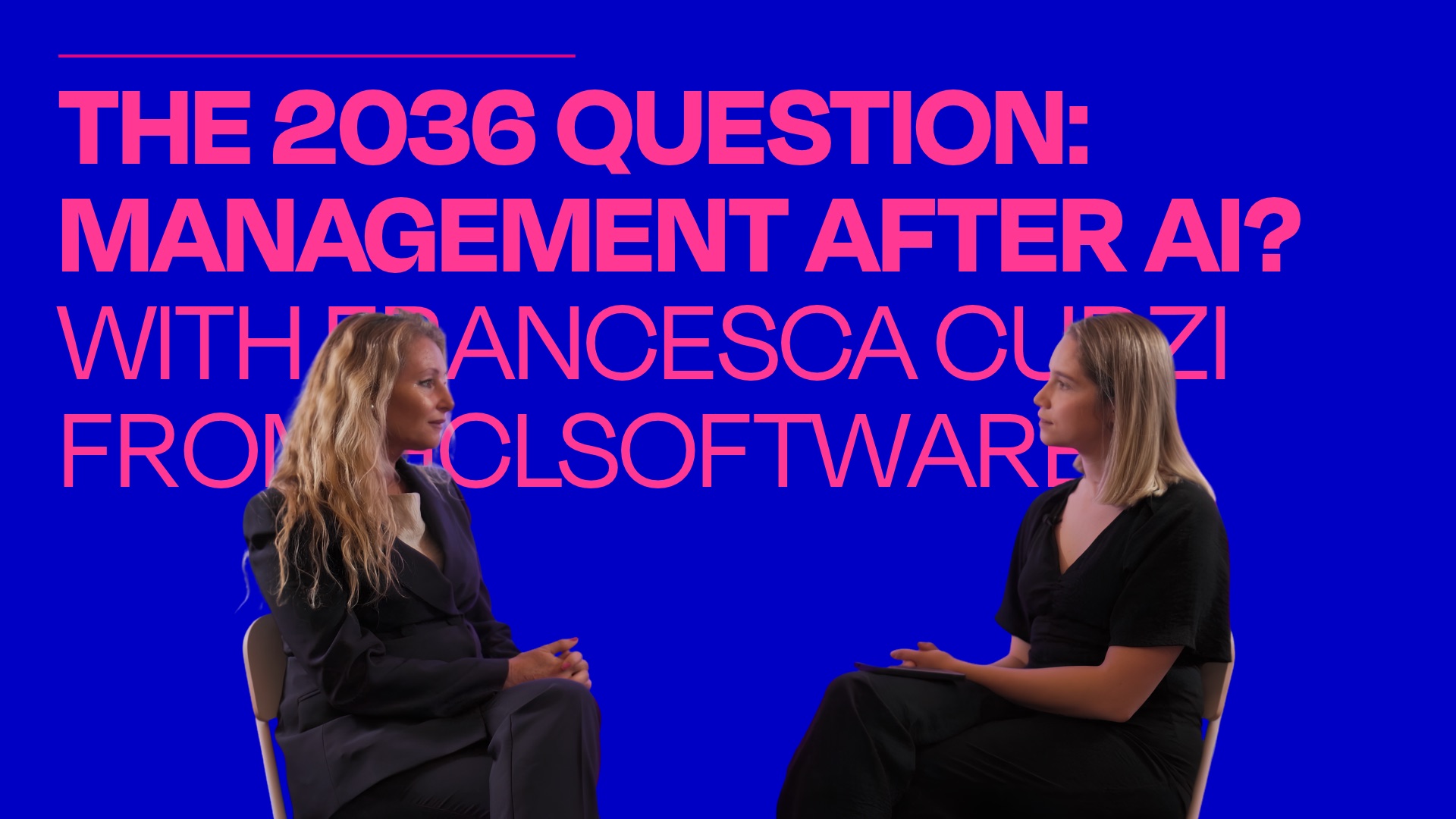
In the second episode of The 2036 Question, HCLSoftware's Francesca Curzi examines a future in which AI agents coordinate processes, reshape the corporate hierarchy and force executives to reconsider what human oversight actually means.
An AI agent can complete a task. It can increasingly decide which task comes next, pass work to another agent and report on the result. At what point does that stop being automation and start looking like management?
That question sits at the center of the second episode of The 2036 Question, Automation Summit's interview series about the decisions that will define the next decade. Recorded during the October 15–16 conference in Split, the conversation brings together host Dina Hrastović and Francesca Curzi, VP and Global Head of Sales at HCLSoftware, to examine a workplace in which the people giving instructions may soon be outnumbered by the systems carrying them out.
Curzi has spent years working with enterprises trying to introduce new technologies without interrupting the systems that keep their businesses running. What she sees across markets is a familiar contradiction: companies can give employees access to increasingly capable AI tools, but that alone does little to change how work is actually organized.
A new organizational chart, but who is in charge?
Enterprise AI is often discussed in the language of productivity: faster reports, fewer repetitive tasks, more output from smaller teams. Agentic AI introduces a different possibility. These systems can coordinate activity and make decisions within workflows—functions that have traditionally belonged not only to employees, but also to their managers.
So what does a middle manager do when tracking progress, distributing tasks and handling routine exceptions can all be delegated? What new skills would a department head need to lead a mixed team of people and autonomous agents? And will industry expertise matter more or less when the person in charge must also understand the technology?
Curzi's answers draw on the practical difficulties of transformation inside large organizations. Banks, multinational businesses and other established enterprises cannot simply erase decades of legacy infrastructure and start again. But as she explains, adding AI to an unchanged process is not necessarily the same as redesigning that process for a different future.
The leadership problem nobody can automate away
The implications extend beyond today's management jobs. If AI takes on much of the routine work once assigned to junior employees, what happens to the years of experience through which future leaders have traditionally been developed?
Hrastović challenges Curzi to imagine the career ladder of an organization in which employees progress by coordinating increasingly capable teams of agents. Would tomorrow's marketing director still need to come from marketing? Should companies hire people who understand the technology, people who understand the business, or an entirely different kind of profile?
And what becomes of employees who do not want entrepreneurial careers, creative roles or the responsibility of supervising machines? The discussion gets into the consequences of that question rather than treating it as a matter of reskilling alone.
A human in the loop is not necessarily a human in control
Then comes a more uncomfortable thought experiment. Imagine an employee approving 500 decisions made by AI agents in a single day. A human is technically still involved. But how much judgment is that person exercising—and who is actually responsible if one of those decisions causes harm?
This is where the discussion moves from job descriptions to the mechanics of governance. Curzi explains why enterprises need to think about what agents can access, how their actions can be audited, which data they can trust and what happens when a company's AI strategy—or the economics of running it—changes.
The questions are hardly abstract for executives deciding whether to deploy autonomous systems across sensitive business processes. Yet there is no single answer that fits every organization or every decision.
The 2036 Question: what will we wish leaders had understood?
The conversation ends ten years from now, in October 2036. Imagine AI agents have become as ordinary to companies as mobile networks or cloud services are today. If competing businesses have access to increasingly similar automated capabilities, what will make one of them better than another?
And, looking back, what will we wish leaders had understood in 2026—about human judgment, organizational change and the decisions we were so eager to delegate?
The second episode of The 2036 Question, featuring Francesca Curzi, is available on the Automation Summit YouTube channel. Watch the full conversation to hear where she draws the boundaries between human responsibility and autonomous work—and what she believes will still distinguish a business in 2036.
The 2036 Question is an original Automation Summit podcast series bringing together entrepreneurs, technologists and business leaders to examine how today's decisions will shape the world of 2036. Recorded during Automation Summit 2026, held October 15–16 in Split, Croatia.